Sunday, December 1, 2024

Ship Recycling Market Outlook Increasingly Positive


Cash buyer GMS notes that despite incoming president Trump’s announcement of applying sweeping tariffs to the tune of 25% on China, Mexico and Canada, the U.S. economy continues to firm as U.S. inflation drops to (globally) fantastic levels and the US Dollar strengthens against nearly all ship recycling nation currencies this week.

The news of the ceasefire between Israel and Hezbollah ceasefire eased tensions around trade routes, and a healthy number of already beach-worthy yet still employed ladies finally make their appearances at the various ship recycling waterfronts, especially Alang.

“With sub-continent markets gradually settling into a familiar routine of introductions and acceptances at the bidding tables at prevailing levels, a fragile sense of stability in a market that has otherwise seen the worse an industry could offer, is gradually starting to come through,” says GMS.

“As recycling nation currencies weaken and steel prices remain shaky, plate levels plummeted in Pakistan (and even Turkey) this week, sending Gadani sentiments further South for the upcoming Winter and all but wiping out sensible exchanges with Gadani buyers.”

Bangladesh descended into a week of virtually no activity at the bidding tables other than local deliveries.

“Overall, as both India and Bangladesh will likely have concluded key elections within Q1 2025, ship recyclers in these markets can hopefully move forward on the back of some sensible modifications to upcoming domestic / infrastructure projects and steel from local yards should start to shift at pace once again.”

The lack of domestic demand for recycled steel within ship recycling nations has been met with a low supply of tonnage over the course of 2024.

Chinese businesses are preparing for a stimulus package, which offers hope for steel plate price patterns at competing nations. The stimulus package is further expected to impact shipping markets and global trade patterns at large, especially as Trump’s announcement of punitive tariffs has already seen economic forces reacting to his intent.

GMS predicts that supply, demand and vessel pricing should improve next year.

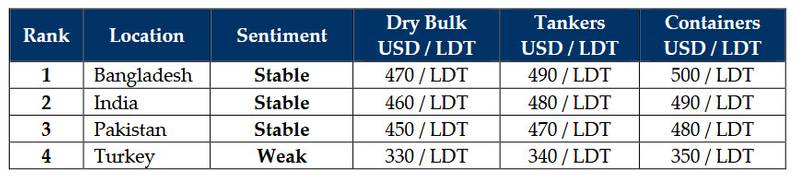
GMS demo rankings / pricing for week 48 of 2024 are:


Bulker Reports Explosion in Cargo Holds Off North Carolina Coast 

The UK-flagged bulker Anglo Marie Louise (114,727 dwt) has returned to an anchorage off Virginia after reports that the bulker suffered an explosion on November 27. There are no indications of injuries to the crew and the vessel remained seaworthy, although according to the report it has suffered damage.

“It is reported that the vessel has sustained damage to the No.1 and No.2 cargo hatches as a result of the explosion,” writes claims consultant WK Webster in its report of the incident. 

The bulker, which was built in 2011 at China New Times Shipyard, departed Baltimore, Maryland on November 23. The explosion occurred while the vessel was approximately 150 nautical miles east of North Carolina on November 27. The vessel has now anchored off Virginia Beach near the entrance to Chesapeake Bay.

The same ship was also involved in an incident in March 2024 when it blacked out while maneuvering on the Mississippi River near New Orleans. A dispatcher from Moran tugboat company detailed the incident in a social media posting reporting the Anglo Marie Louise careened out of control on the river and was heading for the Nashville Avenue wharf. Two tugs were able to intercept the vessel before it hit another docked vessel or the wharf.

Previously, the ship was cited for issues during port state inspections in the early 2020s. Its most recent inspections however reflected no problems.

The vessel is registered in the UK and managed by Anglo Shipping in London. It is 837 feet (255 meters) in length. 


U-Ming to Add Anemoi’s Rotor Sails to Giant Ore Carrier 

Taiwan’s U-Ming Marine is becoming the latest in a growing list of shipowners to adopt wind-assisted propulsion. Bulkers are a popular category for the technology which is now planned for a broad range of vessel sizes.

U-Ming plans to add rotors made by the UK’s Anemoi to one of the largest bulkers in the world. Under the agreement announced today, November 28, they plan to retrofit four of Anemoi’s rotors to one of the line’s largest bulk carriers. The illustration shows Grand Pioneer (324,963 dwt) fitted with rotors. The vessel was built in China in 2020 and is 1,115 feet (340) meters in length and registered in Singapore.

Each of the rotors will stand 115 feet (35 meters) off the deck with a diameter of approximately 16 feet (5 meters). The installation is to be completed at the end of 2025. Anemoi reports an anticipated 10 to 12 percent fuel savings for the vessel operating on deep-sea routes between China, Brazil, South Africa, and Australia.

The system includes Anemoi’s technology so that the rotors can be folded down when not in use. This addresses concerns for air draft and also ensures they do not interfere with port operations.


The rotors fold down to provide clearance for port operations (Anemoi Marine Technologies)


“These state-of-the-art rotor sails will play a key role in our decarbonization strategy and will complement our portfolio of existing emission-reducing technologies, including a fleet of LNG dual-fuel vessels,” said CK Ong, President of U-Ming. “In addition, we will continue to research other emission-lowering pathways such as carbon capture systems and retrofitting conventional vessels to Methanol dual-fuel.”

The first of the rotor installs on large bulkers was reported by Anemoi completed in June 2023 on the TR Lady (82,000 dwt) Kamsarmax bulker. The retrofit took place on the vessel operated by Tufton in China. It received three 24-meter (79-foot) rotors on rails so that they could be moved to permit cargo operations. Anemoi reported it expected more than 10 percent fuel savings.

Berge Bulk also worked with Anemoi on a retrofit adding four of the larger rotors to its Valemax ore carrier Berge Neblina (388,000 dwt). The vessel began its first voyages with the rotors in the summer of 2023.

The installations on the biggest bulker will be carried out with Vale. Last year the company agreed to install five of the large rotors on its 400,000 dwt Valemax ore carrier Sohar Max. It also reported in October 2024 that Vale along with NS United Kaiun Kaisha (NSU) agreed to install five Anemoi rotor sails on the 400,000 dwt VLOC NSU Tubarao. Built in 2020, the massive vessel is expected to complete its retrofit around September 2025.

The rotors are competing with other sail technologies that are also being fitted on bulkers. Japan’s Mitsui O.S.K. is proceeding with its rigid sail on bulkers. The company has also reported plans to combine the rigid sails and rotors on a vessel. The 62,900 dwt vessel they reported would be built by Oshima Shipbuilding and would be chartered by ENVIVA to transport wood pellets. By combining the two systems on one vessel they expected to increase the reduction in fuel consumption by up to 20 percent.


Westinghouse and Core Power Partner for Floating Nuclear Power Plants 

Westinghouse Electric Company, one of the leaders in nuclear power, and Core Power are launching a cooperation for the design and development of a floating nuclear power plant using a microreactor. According to the companies, by leveraging shipyard capabilities, it will be possible to deploy nuclear energy to islands, ports, coastal communities, and industry.

“There’s no net-zero without nuclear,” said Mikal Bøe, CEO of Core Power. “A long series of identical turnkey power plants using multiple installations of the Westinghouse eVinci microreactor delivered by sea creates a real opportunity to scale nuclear as the perfect solution to meet the rapidly growing demand for clean, flexible and reliable electricity delivered on time and on budget.”

The companies highlighted that floating nuclear power plants can be centrally manufactured and easily transported to operation sites, combining advanced nuclear technology with shipyard efficiency. As a highly transportable source of nuclear power, the eVinci microreactor they contend is perfectly suited to floating applications. The eVinci microreactor Westinghouse says requires minimal maintenance and can operate for eight years at full power before refueling, allowing for reliable long-term power generation at almost any location.

Westinghouse's microreactor would be the basis for the floating power concept (Westinghouse)


Under the agreement, Westinghouse and Core Power will advance the design of a Floating Nuclear Power Plant using the eVinci microreactor. They highlight that using heat pipe technology will improve reliability while providing a simple, non-pressurized method of passively transferring heat. Heat pipes in the eVinci microreactor transfer heat from the nuclear core to a power conversion system, eliminating the need for water cooling and the associated recirculation systems. In addition, the companies will collaborate to develop a regulatory approach to licensing floating systems.

Jon Ball, President of eVinci Technologies at Westinghouse highlights that it will provide “innovative use cases where power is needed in remote locations or in areas with land limitations.” It could be both a steady source of power as well as potentially a way for future disaster relief efforts.

The eVinci microreactor has very few moving parts, working essentially as a battery, providing the versatility for power systems ranging from several kilowatts to 5 megawatts of electricity says Westinghouse. It can run consistently for eight-plus years without refueling. It can also produce high-temperature heat suitable for industrial applications, including alternative fuel production such as hydrogen. The microreactor is factory-built and assembled before it is shipped in a container.

This is one of several projects looking at the concept of creating floating small-scale nuclear reactors to provide power to remote areas. Samsung is also working on a concept to use the next-generation molten salt reactor for a floating power plant. 

Crowley also partnered with BWX Technologies, which for many years was part of the well-known Babcock & Wilcox Company. This project is also exploring the development of a power generation vessel concept using a microreactor. 

There is an increasing focus on nuclear power as a part of the solution to decarbonization. The projects have projected by the 2030s it would be possible to begin to build and deploy floating reactors.


Maersk Names Next Methanol Ship for Founder A.P. Møller

The rollout of Maersk’s dual-fuel methanol containerships continued with the naming ceremony in Singapore for the A.P. Møller. The vessel, which is the ninth in the line’s fleet able to operate on methanol was named in honor of Arnold Peter Møller, founder of the company.

A.P. Møller (174,000 dwt) is part of the series of 18 large dual-fuel methanol vessels being built for Maersk and scheduled for delivery in 2024 and 2025. Built at Hyundai Heavy Industries in Ulsan, South Korea, she can carry 16,592 TEU. Maersk reports she is the seventh of these large dual-fuel methanol vessels to join the Maersk fleet in 2024, following sister ships including Ane Maersk which was the first of the class which was named in January. Others include Astrid Maersk, Antonia Maersk, Alette Maersk, and Alexandra Maersk.

The newest vessel of the class, A.P. Møller departed from Ningbo, China on November 16 to start her maiden voyage. She has made stops in Shanghai, Nansha, and Yantain, China before arriving on November 27 in Singapore. She is due to depart on November 29 with her next scheduled stops in Malaysia and Sri Lanka. Ms. Chan Su-Shan, the wife of the CEO of Temasek Holdings was the godmother of the vessel during the ceremony on November 28.

Naming ceremony for the newest vessel took place in Singapore during its maiden voyage (Maersk)


“Today marks a significant milestone in our journey of decarbonizing the maritime industry,” said Murali Pillai, Minister of State, Ministry of Law and Ministry of Transport in Singapore during the naming ceremony. “The arrival of A.P. Møller in Singapore not only showcases the advancements in shipping technology but also reinforces our commitment to support solutions that can reduce greenhouse gas emissions.”

Singapore officials highlighted that the port also conducted the inaugural ship-to-containership methanol bunkering for the Laura Maersk in July 2023. The feeder ship was the first introduced built to operate on methanol. Maersk also recently completed the first conversion of an in-service containership to dual-fuel methanol capabilities. 

The delivery of the dual-fuel fleet Maersk highlights as a significant component of its decarbonization goal of achieving net-zero greenhouse gas (GHG) emission by 2040. During a press briefing in Singapore, Maersk told reporters that alternative fuel last year accounted for just three percent of the approximately 10 to 11 million metric tons of fuel it uses each year. 

The line projected its alternative fuel use would probably rise to between 15 and 20 percent by 2030. They noted that however, the fuel strategy anticipates that it will be using a combination of biodiesel, green methanol, and bio-methanol. They have discussed the supply concerns for alternative fuels while again emphasizing the price gap and the need to support the transition to alternative fuels.

The new vessel, A.P. Møller reportedly loaded 500 metric tons of green methanol before it departed the HD Hyundai Heavy Industries shipyard earlier in the month. The new large dual-fuel vessels have the capacity to carry 16,000 cubic meters of methanol for a trip from Asia to Europe and back to Asia. The vessels are powered by MAN dual-fuel engines


Thursday, November 21, 2024


How Chennai-Vladivostok Shipping Corridor Will Reshape Regional And Global Trade Networks
news-details

In a groundbreaking move poised to reshape trade networks, India has operationalized the Vladivostok-Chennai Maritime Corridor (VCMC), a strategic shipping route linking Chennai, India, with Vladivostok, Russia.

Union Minister of Ports, Shipping, and Waterways Sarbananda Sonowal, speaking at the Sagarmanthan conference, announced plans to extend the route to include additional east coast ports Paradip and Visakhapatnam, signaling a significant leap in maritime connectivity.

The initiative, co-hosted by the Ministry of Ports, Shipping, and Waterways and the Observer Research Foundation (ORF), underscores India’s commitment to enhancing trade links with Russia and integrating itself deeper into global trade systems.

Strategic Importance of VCMC

The Chennai-Vladivostok Maritime Corridor spans 5,600 nautical miles and serves as a vital conduit between South Asia and the Russian Far East. Vladivostok, Russia’s largest Pacific port, lies merely 50 kilometers from the Russia-China border, making it a strategic trading hub with direct access to Northeast Asia.

The corridor’s geographical route traverses critical maritime regions, including the Sea of Japan, the South China Sea, the Strait of Malacca, the Bay of Bengal, and the Andaman and Nicobar archipelago. This positioning not only facilitates efficient trade flows but also enhances India’s influence in the Indo-Pacific, a region increasingly central to global geopolitics.

Current and Future Trade Dynamics

The VCMC is already facilitating two-way trade. India imports petroleum and liquefied natural gas (LNG) from Russia, while exporting textiles, engineering goods, and machine parts. With the addition of Paradip and Visakhapatnam ports, the route will cater to a broader spectrum of commodities, increasing the corridor’s economic viability and fostering regional trade integration.

“This maritime corridor has immense potential to redefine trade relations between India and Russia while simultaneously reducing dependency on traditional supply chains dominated by Western powers,” said Sonowal during his address at the conference.

The corridor is also strategically aligned with India’s efforts to diversify its energy imports. By importing oil and gas from the Russian Far East, India can reduce reliance on the volatile Middle Eastern energy markets.

A Faster, Cost-Effective Alternative

Compared to existing maritime routes, the VCMC offers a faster and more strategic alternative. The reduced transit time between India and Russia not only cuts shipping costs but also ensures reliable supply chains, especially during times of global uncertainty.

“The success of this route lies in its ability to provide a seamless connection to global markets,” said an official from the Ministry of Ports. “It is particularly appealing to exporters as it reduces logistical challenges and delivery times.”

Strengthening India-Russia Ties: The VCMC is a testament to the evolving India-Russia relationship, characterized by deepening trade and strategic partnerships. Amid geopolitical shifts, the corridor provides an alternative route for commerce, bypassing Western-dominated sea lanes.

A Pivot to the Indo-Pacific: For India, the corridor is not just about bilateral trade with Russia but also about increasing its footprint in the Indo-Pacific. The route traverses critical maritime chokepoints and aligns with India’s Act East Policy, strengthening ties with Southeast Asian nations.

Diversifying Global Supply Chains: The VCMC serves as a counterweight to existing supply chains that predominantly rely on China and Western nations. With disruptions caused by geopolitical tensions and pandemics, the corridor offers a resilient alternative for trade.

Infrastructure and Connectivity Boost

The success of the VCMC hinges on robust port infrastructure and enhanced connectivity. The planned integration of Paradip and Visakhapatnam ports will bring more industries and exporters into the fold, expanding the corridor’s operational scope, reports Mint.

Additionally, investments in port infrastructure, modern shipping facilities, and digital systems for tracking cargo will play a pivotal role in ensuring the corridor’s efficiency.

India’s focus on maritime connectivity reflects its ambition to become a central player in the global trade ecosystem. The Chennai-Vladivostok route, with its strategic and economic potential, is poised to be a cornerstone of this vision, reshaping not just regional but global trade dynamics.

Source: Swarajya 

#theshippingtribune #latestnews #shippingnews #dailynews #Maritimenews #shippingindustry #chennai #shipping
 

Shipping giant to move operations from major port

news-details

A major container shipping company has announced it will no longer use the Port of Felixstowe for its larger vessels from next year.

Maersk said the changes would take effect in February following a review of its Asia-Europe shipping routes.

The firm said it had concluded the London Gateway on the Thames estuary in Essex was "the most optimal port to serve our customers" in the UK.

It said it expected to share further details "over the next couple of weeks".

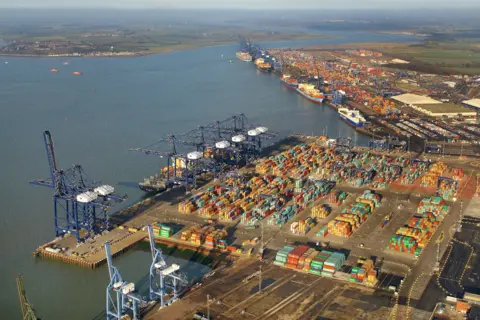
Mike Page Aerial Photography An aerial view of the Port of Felixstowe, showing cranes, containers stacked on the quays and half a dozen ships docked. In the background are is the village of Shotley Gate and the River Orwell.Mike Page Aerial Photography

Felixstowe has described itself as Britain's busiest container port

In a statement on its website, Maersk said the changes were part of the Gemini Co-operation, which is a review of its network carried out with the Hapag-Lloyd shipping company.

"During this optimisation process... we have concluded that London Gateway is the most optimal port to serve our customers importing/exporting cargo to/from the UK," it said.

"Due to this change, Felixstowe will not be a part of Maersk and Hapag-Lloyd’s shared Gemini network.

"The previously announced Middle East-Europe (London Gateway) and Trans-Atlantic (Southampton) Gemini services remain unchanged."

It added: "There are no changes for Maersk’s own operated services to/from Felixstowe outside the scope of the Gemini Co-operation."

Maersk has not said what this means in terms of the number of its ships that will not dock at Felixstowe any more.

However, the BBC understands the decision means Felixstowe will see about two fewer large vessels at the port each week.

Felixstowe's quayside has the capacity to welcome the world's largest container ships, which can carry upwards of 20,000 containers.

Maersk's smaller ships, which serve shorter sea routes, are still expected to call at the port.

The news comes a month after it was announced £1bn was to be pumped into expanding London Gateway, which opened for business in 2013.

Source: BBC 

#theshippingtribune #latestnews #shippingnews #dailynews #Maritimenews #shippingindustry #maersk